Why Supporters Repeat the Same Matchday Rituals
Why supporters repeat the same matchday rituals: familiar cues preserve personal memories, mark changing seasons, and help supporters recall how a game felt.

The most common mistake with matchday rituals is treating them as attempts to influence the score. That turns a scarf pulled from the same drawer or a song heard on the walk in into a superstition that must work. Why supporters repeat the same matchday rituals is often simpler: repetition gives the season a personal record, one familiar cue at a time.
Rituals As Memory Cues
A matchday can attach itself to an ordinary detail: the paper program folded into a coat pocket, the sound of a vendor calling from the same corner, or a particular radio broadcast on the drive. Later, that cue can bring back more than the score. It may summon the weather, the company, or what was happening in life beyond the ground.
This is different from keeping a formal archive. A supporter may not remember every lineup, but still recall which jacket was worn during a long run of away games or the seat where a parent explained the offside rule. The repeated object or action becomes a handle for a larger memory.
That handle is imperfect. Two people can share a route and remember the afternoon differently, especially after a tense result. A ritual provides a place to begin remembering; it does not preserve a complete or neutral account.
Objects That Gather Time
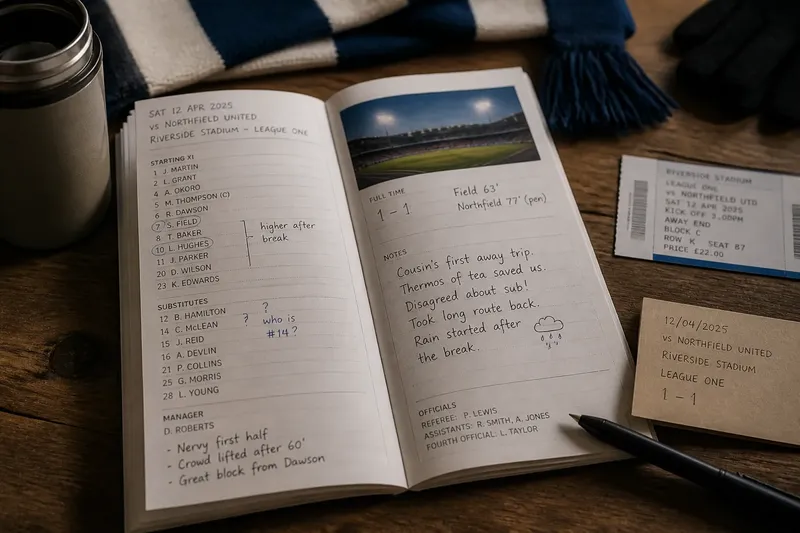
Scarves, ticket stubs, worn caps, and travel mugs can collect associations through use. Their material value may be modest, yet each can stand for a particular stretch of a supporter’s life: the season of taking a child to games, the years of a long commute, or the first matches after moving to a new city.
Keeping every object is not necessary. If a ticket stub is fading, a supporter might write the opponent and a short memory on the back before placing it in a small box. If the box is already crowded, choosing a few meaningful items can make the collection easier to revisit. The point is to preserve what helps recall, not to save every scrap.
Imagine a supporter has a faded paper ticket from a rainy cup tie and remembers only that an old friend came along. They write the friend’s name and “shared an umbrella” on the back, then file it with a handful of other tickets. When they look through the box later, the note gives the object a specific human detail, though it does not settle every part of the memory.
Seasonal Patterns
Some rituals chart time through repetition. A supporter may always buy a match program at the season opener, take the same photograph outside the ground on the final home fixture, or notice how daylight changes along a regular walk. The action becomes a marker against which the season’s changes are visible.
These patterns can hold contrasts as well as continuity. The route may be unchanged while familiar faces disappear from the usual meeting spot; a song may sound different after a difficult season. Rather than making every game feel the same, a recurring cue can make differences easier to notice.
For anyone who wants a simple record, a pocket notebook can hold a date, opponent, one sensory detail, and a few words about the company. That is enough to prompt recollection without turning every match into an assignment. A phone note or a caption on a photograph works just as well.
What Does A Ritual Preserve?
Do matchday rituals help people remember games?
They can provide recurring cues that bring back associated details, such as a route, object, or companion. The memory remains personal, and a ritual does not preserve a full record of what happened.
Should I keep every ticket or program?
No. Keep items that prompt a particular memory, and let go of those that have no meaning for you. A brief note or photograph can preserve a detail without creating a large collection.
Can the same ritual feel different each season?
Yes. A familiar action can sit beside changing circumstances, people, and moods. Its repeated form can help make those differences noticeable rather than erase them.
What is an easy way to record matchday memories?
Write down the opponent, one concrete detail, and who was there in a notebook or phone note. Keep it short enough that recording the day does not distract from experiencing it.
Keep The Useful Details
A small record can help a memory return, but elaborate cataloging is rarely worth the effort unless you genuinely enjoy it. There is no need to label every photograph, preserve every ticket, or reconstruct each match in detail. Choose the cue that carries meaning for you, and let the rest remain ordinary.
Why supporters repeat the same matchday rituals often becomes clearest years later, when a familiar object or sound brings back a person or a season. If you keep one thing from a match, make it a detail that helps you remember the day as you lived it—not just how it ended.