The Match Programme as a Keepsake of a Day
A match programme becomes a keepsake when you annotate its line-ups, ticket details and small matchday clues, preserving a personal record beyond the score.
The common mistake with a match programme is to treat it as disposable paper, then discover later that the score alone cannot bring the day back. A match programme keepsake can hold the line-up, a hurried note, and the small details that made one game feel like yours.
Imagine that Maya, an invented supporter, attends a Saturday match with her older cousin. She buys a printed programme at the ground, folds it into her coat pocket, and takes it home. The game ends in a draw. The result is easy enough to look up, but Maya wants to remember more than that. Her programme gives her a place to build a personal record without turning the afternoon into a scrapbook project.
Choose the useful details
Maya starts by deciding what she would want to know if she opened the programme years later. She writes the date and the opponents on the inside cover, where the information is easy to spot. If the venue or competition is not clear elsewhere, she adds that too. These basic details give the object a setting.
She does not try to document every minute. Instead, she chooses a few clues that would help her recall the day: the player who made an unexpected start, the first name her cousin mentioned on the way in, and the point in the match when the crowd changed tone. Brief notes are enough. “Nervy first half” may mean more to her later than a paragraph of play-by-play.
The useful question is not, “What happened in the whole match?” It is, “What would I forget first?” A supporter may remember a spectacular goal but lose the detail that a new player made a debut, or that a relative explained a familiar chant on the walk to the ground. The programme can preserve those personal edges alongside the official record.
Read the line-up twice
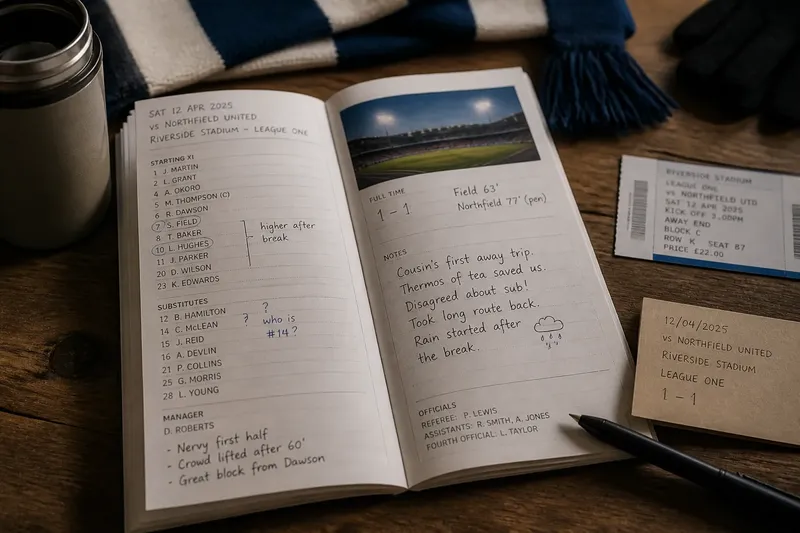
Before kick-off, Maya checks the printed line-ups. She circles the players she recognizes and marks a small question mark beside one name she cannot place. During the match, she learns that this player has been moved into a different role. In the margin, she adds a short note: “higher after break.” The annotation connects the printed list to what she actually saw.
Line-ups are especially useful because they capture a moment before the game reshapes itself. A programme may show the planned starters, substitutes, and staff, while a handwritten mark records a late change or a personal reaction. If the official sheet differs from what happened on the field, Maya can note the change rather than silently correcting the print. The contrast is part of the record.
She also leaves space for uncertainty. A name she cannot identify does not need an immediate explanation; a question mark can preserve what she was still learning. If she later checks the club’s match report or asks her cousin, she can add the answer in a different ink or a small note on a slip kept with the programme. That way, the memory of learning and the later correction remain distinct.
Keep the human margin
The programme’s printed content belongs to the event, but Maya’s most vivid notes are about the company she kept. She writes that her cousin brought a thermos, that they disagreed over a substitution, and that they took the long route back to the station. None of those details changes the match record. They explain why the afternoon stayed with her.
She avoids writing over photographs, signatures, or information she may want to read later. A pencil or fine-tip pen in a clear margin is easier to manage than a thick marker across a page. She also avoids adding private details about other people that she would not want a future reader to see. A keepsake can be personal without becoming indiscreet.
One compact note can do several jobs: “Cousin’s first away trip; rain began after the break; shared chips on the train.” Maya does not need to make the programme look polished. A slightly uneven note in her own handwriting can be more evocative than a carefully arranged page, because it preserves the pace and attention of the day.
What should you write down?
Should you write the final score?
Yes, if it is not already easy to see on the programme. Add the score and, if it matters to your memory, who scored or when the decisive moment came. Keep the note factual and brief so it does not crowd out personal details.
What if the line-up changed?
Mark the change beside the printed name or in a nearby margin, and distinguish what was printed from what you observed. A note such as “came on for the second half” gives future-you a useful clue without rewriting the original list.
Can a digital photo replace the paper?
A photo can preserve the pages and make them easier to share, but it may not carry the feel of the folded programme or the handwriting in quite the same way. Maya chooses to photograph the marked pages as a backup while keeping the original in a sleeve at home.
How much annotation is enough?
Enough to identify the day and recover a few moments that mattered to you. If you find yourself trying to record every passage of play, pause and keep only the details that would be hard to retrieve from a scoreline or match report.
Make a record, not a project
After the match, Maya lets the programme dry fully before storing it. She slips it into an archival-quality paper sleeve, writes the date and opponents on a small separate card, and keeps the card with the programme rather than sticking labels onto the printed cover. If she wants to add a ticket stub, she places it alongside the pages instead of taping it across them.
There is no need to buy a display frame, collect every edition, or decorate the programme with elaborate materials. Those efforts can shift attention from the memory to the presentation. For a single keepsake, a clear sleeve, a simple note, and a sensible place away from damp and direct light are usually enough to keep it accessible.
Maya’s finished programme is not a complete account of the match. It is a record of what she noticed: the starting line-up, a tactical change, her cousin’s commentary, and the journey home. The draw remains the result, but the annotated pages carry a fuller memory of being there.
A match programme keepsake works best when its owner chooses details that belong to that particular day. A score can tell you what happened; a penciled name, a crossed-out prediction, or a note about the person beside you can tell you what you were paying attention to. When you open it again, those small marks give the game a way back into view.